This nonfiction book is subtitled From Ocean Waves to Light Waves via Shock Waves, Stadium Waves, and All the Rest of LIfe's Undulations. So, with a title like that, how could I resist? Especially the "life's undulations" part. And that is exactly what the author talks about...waves of all kinds. About one-quarter of the information was over my head, it being physics and such, but so much was fascinating, relatively easy to understand and often funny. The illustrations were superb with photographs and paintings and diagrams. He would often also illustrate with quotations.
His previous book was The CloudSpotter's Guide, which I haven't read and didn't know existed. These books are not exactly best sellers; still, The Wave Watcher was chock full of interesting facts about water waves, light waves, sound waves and electromagnetic waves, etc. Gamma rays, for instance, are electromagnetic waves and have the highest frequency and shortest wavelength. They are produced by radioactive materials and can be dangerous and destructive but are also beneficial when they are used in radiation treatments to target and kill cancer cells.
"Have you ever woken in the middle of the night with the horrifying realization that you haven't the faintest idea what an electromagnetic wave is? [asks the author] Me neither. But since these waves are everywhere around us, I felt that it might be a good idea to find out." And he does.
The locomotion of worms, the "mucociliary escalator" that is inside your windpipe, or a "word" as Oliver Wendell Holmes describes it: "A word, whatever tone it wear, is but a trembling wave of air." Or guitars and sympathetic resonance, or breaking the sound barrier, or the Corryvreckan Maelstrom, or the electron microscope, Einstein, quantum physics and Luc De Broglie who won the 1929 Nobel prize in physics for figuring out the "wave behavior of elections." This is not nearly as boring as it probably sounds to most people. I found I could let go what I didn't understand and still enjoy this delightful, witty writer and his quirky curiosity.
At the end, he decides he needs to go to Hawaii on what he calls a "research trip" to study the huge surfing waves. And so into a world of boogie boards, body surfing, pipelines, death....
The author decides to try bodysurfing: "They were too fast for me to catch, and I felt foolish, frustrated and drained This was ridiculous. Who did I think I was kidding? I'm no bodysurfer, I thought to myself, spitting out yet another mouthful of salt water. And then I gave up worrying....."
OK, now look up viola d'amore. Vignettes like the one about the viola d'amore were what made this book such a treasure.
Sunday, December 5, 2010

Carolina Wren
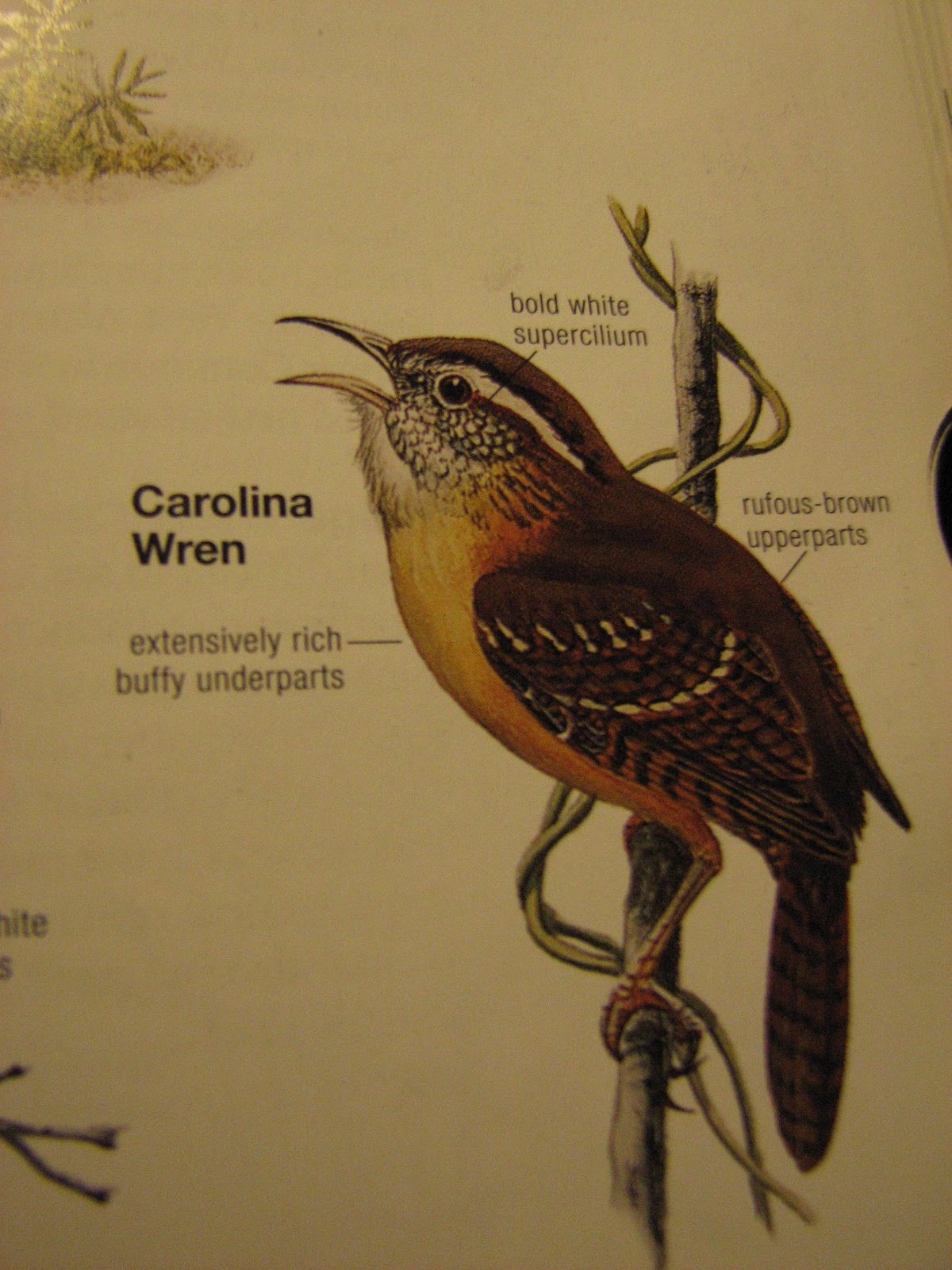
Here is why I love birding...
Today there were "lake-effect" winter storm warnings all day. It was blustery, about 30 degrees, with alternating blowing snow and periods of quiet. It went on like this all day. This was my weekend to work, so I sat with a view of all my feeders for two days straight, since there is window right next to my work computer. I had the usual birds...a nice collection of about a dozen species, including doves, a cardinal, bluejays, juncos, woodpeckers, etc., but nothing out of the ordinary.
So on Sunday afternoon, I looked out and saw a bird that almost immediately seemed not ordinary. It was hanging on one of the feeders, and at first I though "finch." I haven't seen many house finches OR purple finches this year, and they are good possibilities at feeders, but then I realized I was looking at a Carolina Wren! This was thrilling for me. I have NEVER actually seen a C. wren. When Deborah and I went on the last-of-season birding hike with Don at Ft. Harrison in Indiana late this fall, he heard (so I also heard, but would certainly not have known the song without his expert ear) a Carolina wren. They are usually south of here, and they usually do not show up at feeders in Michigan during a lake-effect mini blizzard. It made me catch my breath. I was delighted, excited, happy.
The Carolina is a large wren, with a strong long white stripe over the eye (supercilium), a long curved bill, a warm rusty wash underneath and a rich brown body like most wrens. It only stayed about 30 seconds, and so far has not returned, but I am positive it was a Carolina.
This bird is mostly a year-round resident in the eastern half of the US, but not as far north as Michigan. Common enough to the south, but not here. Yes!!!!!!
Monday, November 29, 2010
Book: The House on Salt Hay Road by Carin Clevidence
I loved this novel, which is set in rural Long Island from about 1935 to 1945. It is a family story and beautifully told. Two young children whose parents have died are taken in by their aunt, uncle and grandfather and they grow up in the house on Salt Hay Road. All of the characters are beautifully drawn and very credible. One also feels the sea and salty air and the sense of a young boy's freedom as he roams the fields and marshes and beaches that permeates this book. There is also a wonderful nostalgia for people of my generation. It is a time before computers and cell phones and yet not too far removed.
Since I usually read the reviews on the back of books, I thought I would like this story when I read what Annie Dillard said: 'I'd like to see this book return literature to its roots in beauty. Not sentimental, Clevidence has a keen eye for the loneliness of what is real, and for the energy of what is exultant, the white birds rising from the marsh."
Quoting at random:
"Mavis sniffled as she passed Clayton a slice of bread. He smeared it with cream lifted from the top of the milk jug with the flat of the butter knife. The cream was yellow with fat, thick as leather. Clayton sprinkled sugar over it and then crammed the slice into his mouth. The grains of sugar pressed against his tongue."
Clayton is a young boy; Mavis is his older matronly aunt who has returned to the Salt Hay Road house years earlier after a bad marriage. She bakes and cleans and generally keeps house for her father, her brother and for Nancy and Clayton, her orphaned niece and nephew. Her character made me think of my grandmothers in their homes that were always clean and always smelled of good food.
I also liked the way this story was told. The author jumped into these lives and carried us along and then left them, but without a sense of abandonment....rather with a sense that there will be more life for the characters, and that they have been brought through important events in all their lives and now will persevere.
Book: The Charming Quirks of Others by Alexander McCall Smith
This is another Isabel Dalhousie novel. Isabel is a woman who lives in Edinburgh in Scotland and Alexander McCall Smith has written a series of novels starring Isabel. They are all somewhat the same, although her life does move forward chronologically as the series progresses. Isabel has her much younger boyfriend / fiance, Jamie, who is a bassoonist; she has their young son Charlie, her edgy niece Cat (who owns a delicatessen and always pops up as a minor character) and similarly her housekeeper Grace, and Eddie, a socially awkward, rather mysterious young man who works for Cat. The stories are light and mostly sweet but seldom saccharine. McCall obviously loves Scotland and this is a way he showcases his country, and more specifically, Edinburgh.
The bones of The Charming Quirks.... are that Isabel is asked to quietly poke around in the private lives of the three candidates for principal of a boys' school. It seems one of them might have a past that could be problematic should be become the new principal. Of course, Isabel, after a bit of initial hesitation, agrees to take this on. And that is the story. We follow along through her life and her thoughts for a few weeks as she works on this. There is always much of her personal life in these novels, especially her relationships with Jamie, Charlie and Cat.
It is refreshing to read of an older woman and younger man and their child and how it works (mostly) for them. Again, the Isabel Dalhousie series is a comfortable ramble through the life of an intelligent, thoughtful, charming woman. She muses a lot, being a philosopher, but her musings are usually triggered by what happens to her day after day.
I like this series better than the #1 Ladies' Detective Agency Series which also has a female protagonist but is set in Botswana where the author also lived for several years.
Book: Squirrel Seeks Chipmunk by David Sedaris
Sedaris takes familiar animals, anthropomorphizes them and puts them in situations we humans will recognize as we go through life. The stories are mostly very funny, although sometimes startling what with Sedaris' wicked wit. There are 16 stories about rats, stork, hippos, owls, chickens and so on. How better to illustrate what this book is than to offer a quote. This is from The Grieving Owl:
"On my way home that night, I picked up a rabbit. It was on the small side, and and no sooner had I started eating than my mother appeared. "I'll wait until you're finished, " she said in that particular way that means What kind of son can't offer his mother so much as an appendage? Sighing, I ripped off and ear and passed it over. "
Of course Sedaris is mostly pointing out our human foibles and character defects in a uniquely funny way. He contributes to The New Yorker and This American Life on NPR.
Tuesday, November 16, 2010
Sandhill Cranes
Deborah and I met in northern Indiana to see the sandhill cranes at Jasper-Pulaski Wildlife and Game Management Area. They congregate here and a few other places in the US on their migrations north and south each year.
We first met at JP near what would have been sunset had there been a sun. The cranes were flying by the thousands into a pasture in front of a viewing tower, landing, vocalizing and dancing. They arrived from all directions, sometimes singly, but usually in small groups. There was a cold wind blowing and it soon got dark.


We then stayed overnight in a motel 30 miles away and got up at 5 a.m. the next morning to return to see the birds at what would have been sunrise had there been a sun. Still, even without the added beauty of sunshine, it was amazing. The cranes were silvery gray with long necks. They kept flying in, silhouetted against the grey skies, gliding and flapping and dropping down to land for over an hour. We each took about 200 photos. I discarded most of mine but did get a few. Deborah took some small videos and recorded the warbling. Several people had huge lenses, and it was fun to eavesdrop as they all tried to find the correct light settings and exposures and shutter speeds, etc. Deborah and I both said we might come back on a sunny day, although it would mean a 5-hour round trip for both of us. Still, the sight of the cranes against the western sky at sunset would be worth it.
I was most entranced by the intersection of gravity and cranes. They simply seemed to have conquered the strictures of gravity and would gently gently drift downward, their spindly legs dangling, and would settle into the group already on the ground.

We then birded the surrounding area for about an hour, seeing several pairs of eastern bluebirds, tree sparrows, red-bellied and red-headed woodpeckers, white-breated nuthatches and blue jays, most in the state tree nursery which is also part of Jasper-Pulaski.
Mute Swans
Last Saturday, I went to Holland State Park for the Lakeshore Bird Count. This is done in two one-hour segments, from 0730 to 0830 and then from 0830 to 0930. It is done periodically throughout the year, up and down the shoreline. I had never participated before so wasn't quite sure how it was done.
There was a strong, cold east wind. About 6 or 7 of us persevered, although I was absolutely no help at all. Two people had nice spotting scopes and would call out the mergansers, loons, gulls and ducks that I could barely see even as specks through my binoculars. Still, I learned how flight patterns help sort out flying waterfowl. I do see a scope in my future as birds continue to seduce me.
We stayed at the end of the pier for the first hour and then huddled behind the little brick NOAA weather station on the shore. My fingers and toes were pretty numb when 0930 finally arrived.
The highlight for me was two mute swans which came from the west and were flying low and straight east down the channel toward Lake Macatawa. As they approached and passed over, we could easily hear the lovely wild noise of their wings beating the air.
Subscribe to:
Posts (Atom)